

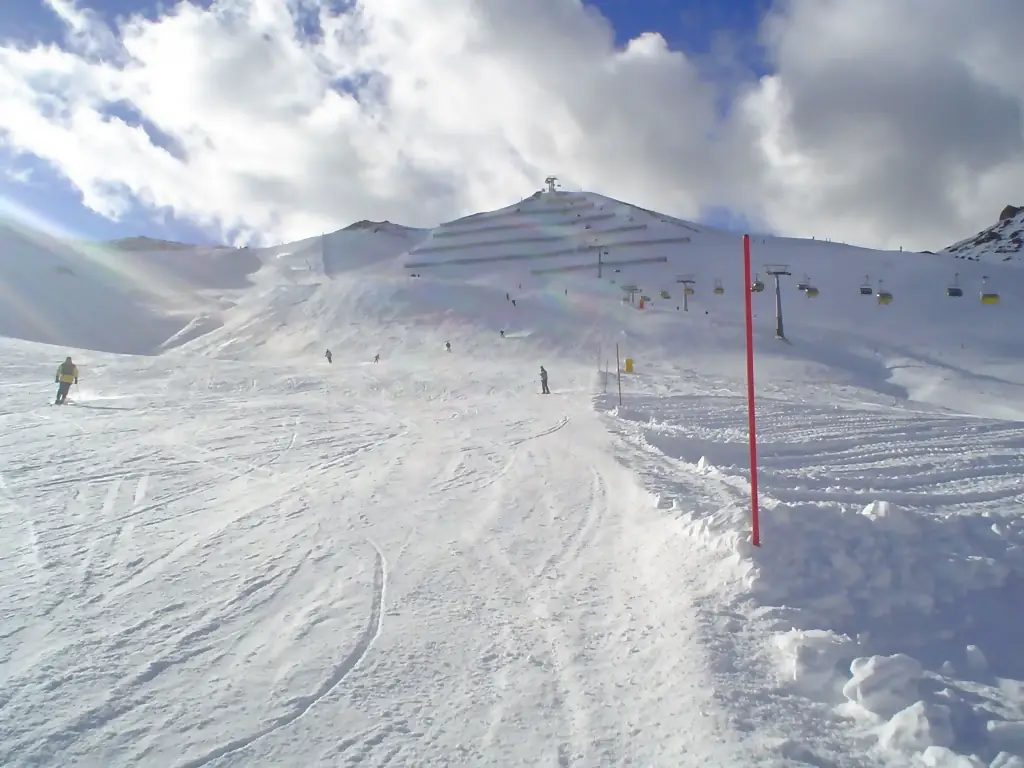
Cable car · Trentino Alto Adige
Sass Pordoi cable car
Sass Pordoi cable car to the terrace of the Dolomites: a flat summit at 3,152 m with a 360° view over the Sella Ronda, open in winter and summer.
Base altitude
2,950 m
Top altitude
3,152 m
Vertical drop
202 m
Length
1,520 m
Affiliate link: if you book through it we earn a commission. The price you pay does not change.
Photo: Guba Zoky Rabko · CC BY-SA 3.0 · Wikimedia Commons
Manufacturer
Leitner
Year built
1947
Hourly capacity
900 p/h
Some mountains impress you with their vertical walls. Others surprise you with how flat they are on top. Sass Pordoi belongs to the second group, and that geological oddity is what makes it unique in the Dolomites.
Its summit is an almost level plateau at 3,152 metres, from which the surrounding mountains spread out in every direction with nothing to block the view. That is why Dolomites enthusiasts the world over call it ‘the terrace of the Dolomites’. The nickname sums up, almost poetically, what sets this mountain apart: a complete 360° view, as if from a terrace hanging in the sky and facing every famous peak in the range.
One of the oldest cable cars in the Alps
The cable car from the station on the Pordoi Pass, at 2,950 metres, to the top of Sass Pordoi is one of the oldest still running in the Alps. It opened in 1947, just two years after the end of the Second World War, at a time when Italy was struggling to get back on its feet economically and morally. It was one of the first major post-war investments in mountain tourism.
Building it was a serious technical challenge for the time. The line already starts at almost 3,000 metres, which made construction work difficult and called for innovative engineering to cope with the extreme conditions.
The top station at 3,152 metres was then one of the highest points in Italy you could reach by lift, a record that gave Sass Pordoi an instant and lasting reputation among mountain lovers. In 1995 the lift was refurbished: its main components were renewed while the original layout was kept intact.
At the heart of the Sella Ronda
Sass Pordoi holds a strategic position on the Sella Ronda, the famous ski tour around the Sella group through the ski areas of Alta Badia, Val Gardena, Val di Fassa and Arabba. It sits on the pass between Val di Fassa and Arabba, and its cable car is a visual and practical landmark for the millions of skiers who ride the circuit every year, clockwise or anticlockwise.
If you go up Sass Pordoi during a ski day, you get a unique view of the whole circuit. Alta Badia, Val Gardena, Val di Fassa and Arabba are all visible at once, an overview of a network of linked ski areas with no equal anywhere in the Alps.
A table mountain of dolomite rock
Sass Pordoi is part of the Sella group, one of the most imposing and distinctive formations in the Dolomites. The Sella is a limestone fortress with sheer walls and a summit plateau that looks like a giant version of Sass Pordoi.
Both are classic Dolomite ‘table mountains’: rock massifs with flat tops that reveal their origin as ancient seabeds, later lifted up and shaped by erosion.
Dolomite rock, a magnesium-rich limestone, takes its name from the French geologist Déodat de Dolomieu, the first to study it systematically. It is this rock that gives the mountains their red-orange glow at sunset, the enrosadira, captured by painters, photographers and poets for more than two centuries.
Summer walks and the summit restaurant
In summer the summit plateau is the starting point for moderate to difficult hikes across the Sella group. In the cold season the same routes become ski touring itineraries for experts.
The mountain restaurant at the top serves traditional Ladin and Trentino food in a stunning setting, and on summer days its outdoor tables make it one of the most spectacular lunch terraces in the Alps.
Photographers love the light on Sass Pordoi. The altitude, the flat summit and the absence of anything in the way let you take panoramic shots from angles you cannot get anywhere else.
Opened in 1947, renovated in 1995. A key point on the Sella Ronda. Open December to April and June to September.