

Cable car · Valle d'Aosta
Plateau Rosa cable car
Plateau Rosa cable car from Cervinia to 3,480 m: Europe's highest Italy-Switzerland link to Zermatt, Matterhorn views and summer glacier skiing.
Base altitude
2,500 m
Top altitude
3,480 m
Vertical drop
980 m
Length
3,200 m
Affiliate link: if you book through it we earn a commission. The price you pay does not change.
Photo: qwesy qwesy · CC BY 3.0 · Wikimedia Commons
Manufacturer
Doppelmayr
Year built
1970
Hourly capacity
1,000 p/h
At 3,480 metres, where the border between Italy and Switzerland becomes an invisible line across the permanent snow of the glacier, lies one of the most iconic spots in European skiing: Plateau Rosa (Plateau Rosà in Italian).
The cable car up from Cervinia is much more than a lift. It is a one-of-a-kind cross-border link that takes skiers from Italy into Switzerland as easily as moving between two valleys of the same ski area.
It opened in 1970 and was completely renewed in 2018 with the latest Doppelmayr technology. Over the years it has become a symbol of European integration in the Alps, and of how deeply this corner of the Aosta Valley is shaped by skiing.
Face to face with the Matterhorn
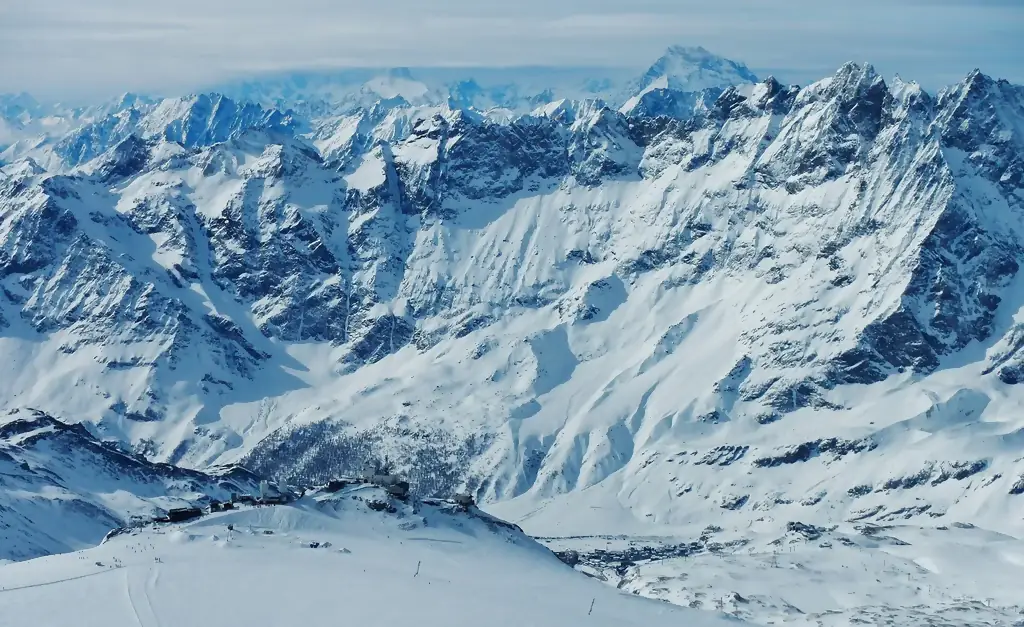
Plateau Rosa has an exceptional setting. The Matterhorn (Cervino in Italian) rises just a few kilometres away, its asymmetric pyramid dominating the skyline like a stage set.
From the top station you see this mountain, one of the most photographed and recognisable in the world, head-on and at close range. Few other places reachable without serious climbing skills offer anything like it.
Every year mountain guides from Cervinia and Zermatt lead thousands of people up the routes to the summit. If technical climbing is not for you, Plateau Rosa gives you the closest and most moving view of the king of the Alps.
Skiing across the border to Zermatt
One of the most unusual things about this cable car is its link with Zermatt on the Swiss side. From Plateau Rosa you can ski on to Trockener Steg and then down to the village at the foot of the Matterhorn, with its traditional chalets and famous car-free streets.
To make the crossing you need an identity document valid for travel abroad, because you really are crossing a national border. Two countries, two alpine cultures and two ski pass systems come together in a single ski experience that is hard to find anywhere else in the Alps.
Summer skiing on the glacier
Thanks to its permanent glacier, Plateau Rosa is one of very few places in Europe where you can ski in every month of the year. Summer glacier skiing draws national teams from every continent for their training camps, amateur skiers who want to stay in shape through the warm season, and the simply curious who want to ski in July or August.
Up here temperatures rarely rise above five or six degrees, even in the height of summer. The snow stays firm and the slopes are well groomed, every bit as good as in winter.
Running a lift at almost 3,500 metres
Operating a lift at nearly 3,500 metres is a real challenge. Wind is the biggest enemy: the top station is exposed to air currents off the Swiss glaciers, and gusts can force the lift to stop even on days that look calm lower down.
Running the cable car in bad weather takes strict procedures and a deep knowledge of local weather patterns, built up over more than fifty years of operation. The structures have to withstand winter temperatures that regularly fall below minus twenty degrees, with several metres of snow over a single season.
A glacier under watch
The Plateau Rosa glacier is also an important scientific observatory for climate change. Its steady retreat over recent decades is documented by regular measurements that show how glacial melting is speeding up across the Alps.
Despite this worrying trend, the cable car still gives access to high-quality snow. Thanks to the altitude and favourable aspect, the ski area remains one of the most reliable in Europe for planning both winter and summer activities.
Renewed in 2018. Italy-Switzerland link open: an identity document is required. Summer skiing from June to August.